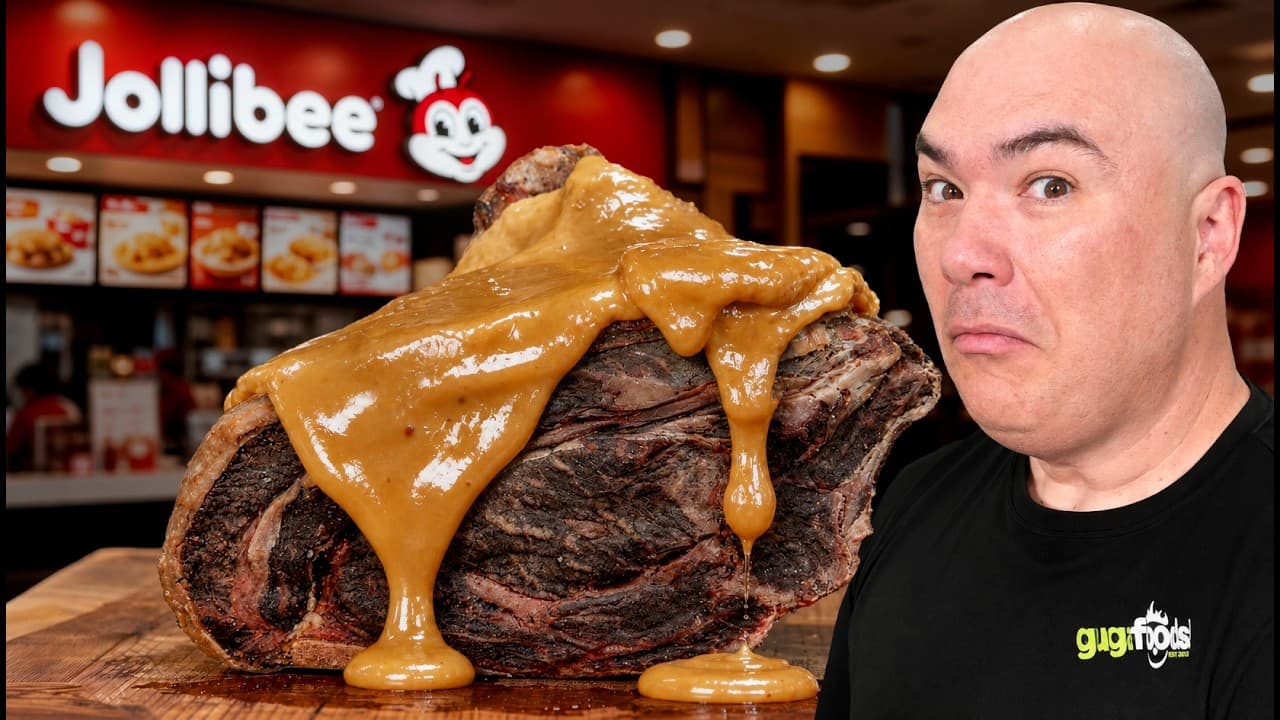
What exactly did Guga do to a ribeye with Jollibee gravy?
Guga Foods, the Miami-based BBQ and steak experimentation channel with millions of subscribers, has built an empire on one simple but irresistible premise: what happens when you do something wildly unexpected to a premium cut of beef? His latest target is Jollibee — the Philippines-born fast-food giant that has grown a ferociously loyal global fanbase — and specifically, its signature brown gravy.
The experiment was straightforward in concept, brutal in execution. Guga submerged ribeye steaks in Jollibee's gravy for seven full days, then pulled them out, grilled them, and stacked them up against two other steaks: a plain control and one treated with a homemade gravy recipe he constructed himself. The goal was to isolate what the gravy actually does to the meat — does it tenderize, does it infuse flavor, does it ruin the crust, or does it do something genuinely special?
For Filipino food fans, this is no small moment. Jollibee's gravy is not just a condiment — it is practically a cultural institution, with devoted fans who will argue passionately about it at any given dinner table.
Who is behind this experiment and why does it matter to the food community?
Guga Foods (real name Gustavo Tosta) has spent years turning his backyard grill into a laboratory. His channel's entire identity is built around long-form steak aging and marinating experiments — he has previously used everything from koji mold to expensive cheeses to dry-age beef in ways that mainstream culinary media wouldn't dare touch. When he decides to test a fast-food gravy, it carries real weight in the BBQ community.
The Jollibee angle adds another dimension entirely. Jollibee has aggressively expanded its North American and European footprint over the past several years, and its gravy — used across its fried chicken and rice meals — has become a reference point in conversations about Filipino cuisine going global. A legitimate food science test from a creator of Guga's caliber gives the chain a kind of cultural credibility that no marketing campaign can manufacture.
For the taste test, Guga also prepared sisig as a side dish, a sizzling Filipino pork dish that added an extra layer of cultural context to the video — though, as fans quickly noted, not without some controversy.
How did the internet actually react to the Jollibee gravy steak video?
The comment section tells a story that the video itself only partially covers.
"Jollibee gravy makes ANYTHING taste better" — @SantoryuAshura
That sentiment is the dominant energy in the thread — a kind of cheerful, unconditional loyalty to the brand that is very specific to the Jollibee fanbase. But not everyone is a believer.
"I was highly unimpressed with Jollibee." — @SaltyBollocks1
The most substantive comment came from @viper1431, who dropped a piece of fast-food insider knowledge that Guga himself didn't address:
"Jollibee gravy uses beef bouillon (cubes) flavour in their gravy powder. McD's uses chicken flavour. If you make it at home like Guga made his and make one lot with beef and one with chicken you will see that the beef one tastes like Jollibee gravy and the chicken one like McD's gravy."
This is exactly the kind of detail that separates Guga's comment sections from the average food channel. His audience actively adds scientific and culinary context, turning the comments into a legitimate companion piece to the video.
The sisig side dish also drew fire. @sigmablock, who claims to have requested this video previously, pivoted quickly to criticism:
"Hold up, I don't know where your researchers got that 'sisig' recipe, but that ain't sisig. Too thick of a cut. You may wanna ask your friend Cooking with Kian the proper way."
This is a recurring dynamic in Guga's videos featuring international cuisines — the communities most invested in those dishes show up ready to fact-check every detail.
Is Jollibee gravy actually worth using as a steak marinade?
Based on the experiment's structure, Guga's methodology is sound — a 7-day soak is long enough for any marinade to make a meaningful chemical impact on muscle fibers, and comparing it against a homemade equivalent is the right control to run. The real verdict lives in the video, but the community's reaction suggests the results were genuinely surprising rather than a predictable letdown.
The request from @davidyork8125 to run the same test with KFC gravy next already has traction, hinting that this could become a full fast-food gravy bracket series. Given Guga's track record of turning viewer suggestions into viral content, that follow-up feels less like a comment and more like a preview.
With Jollibee continuing to expand aggressively across Western markets and Filipino cuisine commanding growing mainstream attention, Guga's timing here is sharp. Expect this video to pull in a crossover audience well beyond his usual BBQ base — and expect the Jollibee-versus-KFC gravy experiment to be announced before the year is out.